
10 Important Things to Know Before Studying Abroad. If you are planning to Studying in foreign countries is one of the most significant experiences in life, which provides students with the chance to get the international education and to experience new cultures and to create international career prospects. Thousands of students are traveling out of their countries to seek higher education in international universities every year. Although the thought of studying abroad is thrilling, it also needs to be planned and prepared.
Students ought to learn about a number of factors before making this huge decision which include finance, cultural differences, visa requirements, and expectations. You can ease the transition process and enjoy your international education experience fully by being well prepared.
1. Choose the Right Country and University
The choice of the appropriate country and university to study is one of the most crucial decisions. Various nations have different education systems, modes of teaching and employment opportunities.
In selecting your destination, take into consideration the following factors:
- Quality of education
- Programs and specializations that are available.
- Cost of living
- Tuition fees
- Language requirements
- Work opportunities after the study.
To illustrate, there are countries that are known to study certain areas of discipline. The United States and the United Kingdom have been found to be popular in business and technology programs whereas other countries such as Germany and Canada have affordable education opportunities with great research opportunities.
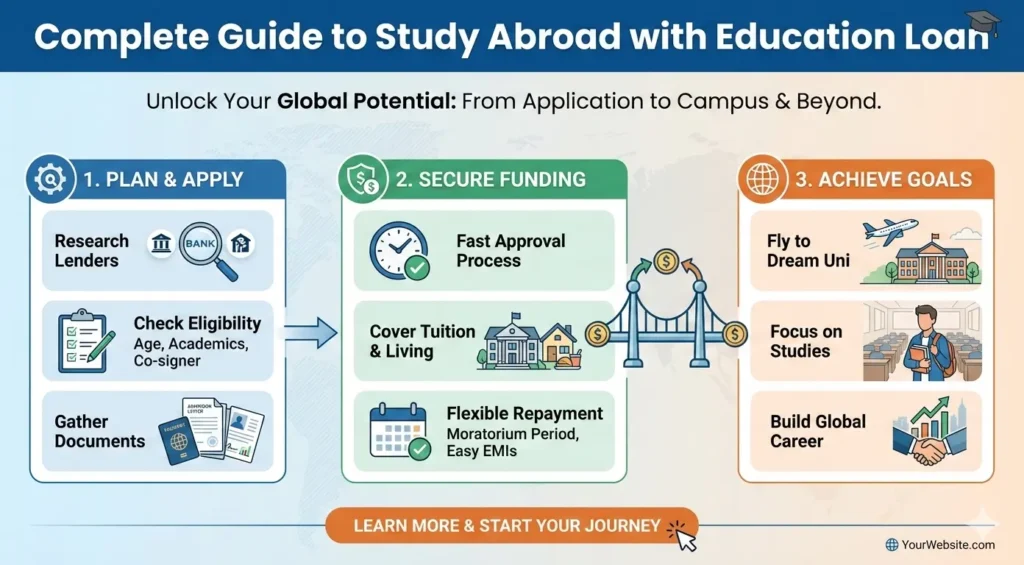
Give time and check on universities, rankings, course structures and reviews by students to make a final decision. If you need financial funding, then Credveda Education Finance Consultant can help you. Simply, you can apply for loan.
2. Understand the Total Cost of Studying Abroad
Tuition costs are a major concern to many students yet the entire cost of studying abroad has a number of other cost implications.
These expenses may include:
- Accommodation
- Food and groceries
- Health insurance
- Transportation
- Study materials
- Visa and travel costs
The price of living also differs a lot based on the nation and city. As an example, education in a large city may be costly compared to that of small towns.
Making a financial plan before you leave your country of origin would enable you to manage your finances more and prevent financial pressures in your studies. Don’t worry you can use the Study Abroad Loan option at a low interest rate.
3. Explore Scholarships and Financial Aid
Scholarships and financial assistance to international students are a fact and many universities and organizations provide them with a chance to study abroad, yet it can be costly.
Scholarships may be based on:
- Academic performance
- Leadership skills
- Financial need
- Particular programs or research fields.
Early applications of scholarships can greatly minimize the costs of studying in a foreign country. Besides scholarships, grants, fellowships, and student loans can also be considered by students.
Explore all the possible sources of funding and seek admission to universities.
4. Understand the Visa and Immigration Requirements
It is vital to have a student visa to study in a foreign country. Every nation possesses its visa procedure and paperwork.
Students usually require the following documents:
- Admission letter in an accredited university.
- Valid passport
- Proof of financial support
- Academic transcripts
- English language test result scores.
- Health insurance
Visa application can be slow taking several weeks or months, that is why it is better to start in time. Delays and rejections can also be prevented by carefully reading the requirements.
5. Improve Your Language Skills
One of the greatest problems that international students may have is language. The problem may be that despite your course being taught in English, you might still have difficulties with the day-to-day communication.
Practice your language before travelling by:
- Training speech and hearing.
- Watching films or talks in the target language.
- Learning apps through language.
- Being part of conversation groups.
Good language skills would assist you to communicate well with professors, classmates and locals.
6. Learn About the Culture and Lifestyle
Each nation possesses its culture, its traditions, as well as social norms. These differences can be understood, which will make it easier to adapt to your new environment.
The cultural differences might encompass:
- Food habits
- Communication styles
- Classroom behavior
- Social etiquette
Indicatively, in some countries, classroom conversation and group participation might be prevalent than others. The knowledge of these cultural expectations will make you feel better and more confident.
Another benefit of studying abroad is the ability to live new traditions, holidays and styles of life.
7. Find Suitable Accommodation
One of the largest issues among students when they go abroad is accommodation. There are various housing facilities in most universities, which include:
- On-campus dormitories
- Shared apartments
- Private student housing
- Local family homestays.
Both alternatives are good. Dormitories offer convenience and chances to find other students whereas shared apartments can be more independent.
It is advisable to have accommodation in advance before entering the country to eliminate the last minute rush.
8. Understand the Education System
The education systems differ in different countries. Other universities pay much attention to the independent learning, research, and critical thinking instead of the traditional lectures.
Students may be expected to:
- Participate in discussions
- Complete research projects
- Work on group assignments
- Place essays and presentations.
In most of the international education systems, time management and self-discipline are the key to success.
Prior knowledge of the academic expectations can make you adjust faster and be good in your studies.
9. Consider Health Insurance and Safety
In most countries, health insurance is compulsory to the international students. It makes sure you will be able to receive medical assistance in case you get sick or hurt in the process of studying.
Prior to traveling, you should know:
- Health insurance coverage.
- Local healthcare services
- Emergency contact numbers
- Campus safety resources
Another tip is to enroll in the embassy or the country consulate when studying overseas.
These measures may be taken to guarantee your safety and tranquility.
10. Prepare for Homesickness and Cultural Adjustment
The relocation to another country may be an exciting yet an emotionally difficult task. During the first few months of staying in a foreign country, homesickness or culture shock develops in many of the students.
This is completely normal. It is a time consuming process to accommodate a new environment.
Some of the coping strategies to homesickness are as follows:
- Keep in touch with relatives and friends.
- Be a member of student clubs and activities.
- New friends of other cultures.
- Discover your new city, new environments.
In order to feel more comfortable with your new home, you can develop a support network and be active.

Additional Tips for Studying Abroad Successfully
In addition to the above noted factors, there are also other tips that would assist you in maximizing the benefit of study abroad.
Plan Your Finances Carefully
Prepare a monthly budget so as to control living costs and prevent excessive spending.
Keep Important Documents Safe
Duplicate important documents like passport, visa and admission letter.
Stay Organized
Organize assignments, exams and personal commitments with the help of calendars and planning tools.
Take Advantage of Campus Resources
Majority of the universities offer services to foreign students such as career counseling, academic advising and mental health services.
Benefits of Studying Abroad
Nevertheless, long term benefits of studying abroad are numerous despite the challenges.
You are able to access the highest quality universities, research institutions and innovative learning to the world.
By being in a foreign land, you get to learn new cultures, traditions, and outlooks.
There are international education which will help make your resume more presentable to the employer and will provide entry to international career opportunities.
The students become independent, confident, and flexible in their life in a new setting.
Conclusion
Studying in a foreign country is a fantastic experience that can help to change not just your education but your whole life. The key to an enjoyable experience is, however, proper preparation.
You can eliminate the pitfalls by researching your destination, learning the prices, managing the culture shock, and budgeting your time in the country of origin, so that you will not have to encounter some of the most frequent challenges.
With that said, it is not only a degree that you get when studying abroad, but it is also about the global experience, making friends that will last your lifetime, and acquiring the skills that will help you in your future career.
It can be one of the most fulfilling experiences of your life as long as you are properly prepared and in the necessary mindset, your international education journey can be.